
About Us
Bellport Fire Department
Established 1893
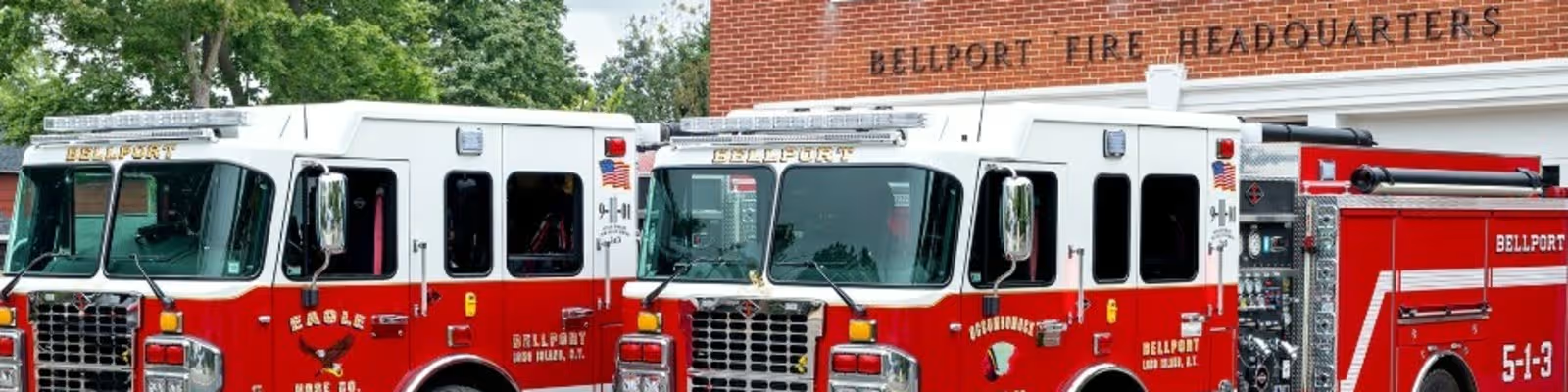
The Bellport Fire Department’s one firehouse is home to the Occumbomock Engine Company, the Eagle Hose Company, the Buzzard Hook and Ladder Company, and the Keystone Fire Police Company.
- Fire suppression, minimize losses
- Emergency medical response
- Ice and Water Rescues
- Fire protection and evacuation
- High-angle Rescue
- Hazardous materials response
- Extractions
- Urban search and rescue
History
Our fire department has a rich history that spans over 130 years. Feel free to read up on how we got to where we are today!
Throughout the Years
Founding Years: 1893-1908
Each time the men and women of the Bellport Fire Department respond to an alarm, they continue a tradition of service that began in the late 1800s. The department’s history traces back to the early 1890s, when several suspicious fires destroyed homes, barns, and businesses in the Bellport area. These losses led concerned residents to organize and create a fire department dedicated to protecting the community.
The Bellport Fire Department owes a great debt to Mrs. Jacob-Nielson Stout, who became one of the driving forces behind the early fundraising efforts. Through block parties, ice cream and cake socials, fairs, and other community events, Mrs. Stout and local residents raised the money needed to purchase land, build a firehouse, and acquire the department’s first equipment. One of the major fundraising events was the Annual Fair, held near the bay where the bandstand stands today. A plaque honoring Mrs. Stout remains in the firehouse as a reminder of her dedication and lasting impact.
On September 9, 1893, the Bellport Hook and Ladder Company held its first official meeting with 32 men in attendance. At that meeting, officers were elected, with Everitt M. Price chosen as Foreman, the position that would later become known as Chief. A committee was also appointed to create a constitution and bylaws for the company. Later that year, the company petitioned the Town of Brookhaven for incorporation, which was approved on December 14, 1893.
Just days later, on December 19, 1893, property was purchased from Charles M. Woodruff for $600. The land was located at the corner of Woodruff Street and South Country Road, the same site where the present-day firehouse stands. A contract was awarded to Robinson and Watkins to build a truck house facing South Country Road. The building was constructed as a shell for $750 and finished by volunteers, showing the strong community involvement that shaped the department from the very beginning.
The department’s first piece of equipment was a hand-drawn hook and ladder truck ordered from Gleason and Bailey Manufacturing Company of Seneca Falls, New York, at a cost of $350. In 1897, the department added a chemical truck from the Rex Fire Extinguisher Company of New York. This equipment used chemical pressure to force water from its tanks, giving firefighters another tool to fight fires before modern pumping engines became available.
In 1898, the department continued to improve its firehouse and alarm system. A steel bell tower was placed on the west side of the truck house, and a bell was purchased for $193. That bell is still mounted in the cupola of the present-day firehouse. In 1901, an additional building known as the “Annex” was constructed behind the truck house.
A major step forward came on October 10, 1905, when the Bellport Fire Department was officially formed. At that time, the term “Foreman” was replaced by “Chief,” with Everitt M. Price serving as Chief and George Piermann serving as First Assistant Chief. The Hose Company was also formed at this meeting and took over responsibility for the chemical truck.
In 1908, the department continued to grow. A hose cart was purchased from C.K. Shaw for $55 and painted white and gold. On March 26, 1908, the Bellport Fire District was created by the Town of Brookhaven, with Charles K. Shaw elected as President of the Board of Fire Commissioners. The first budget was $250. Later that year, the department also repainted its hook and ladder truck white with red and blue stripes and gold leaf, further establishing the department’s identity and pride.
By 1908, Bellport had grown from a small group of concerned residents into an organized fire department and fire district, with its own firehouse, equipment, leadership, and a lasting commitment to protecting the community.
Growth & Modernization: 1908-1938
By 1916, the Bellport Fire Department entered a new era with the purchase of its first motorized fire truck. A Reo motor truck was purchased from the William L. Mantha Company of Bayport for $1,045. Additional equipment, including chemical tanks, was purchased and sent to Bellport, where it was installed at C.K. Shaw’s Blacksmith Shop. This marked an important shift from hand-drawn equipment to motorized fire protection.
In 1921, the department awarded a contract to the Sterling Siren Company for a siren to be installed on top of the bell tower. The siren sounded for the first time at noon on Sunday, March 5, 1922. The alarm button was placed in the local telephone office at the corner of New Jersey Avenue and South Country Road. When an emergency call came in, the telephone operator would sound the alarm and then go to the truck house to tell the responding firefighters where the fire was located. Later that same year, on October 28, 1922, the Engine Company was organized, with Clarence Hawkins serving as Foreman and J. Nelson Hawkins serving as Assistant Foreman.
In March 1924, the department purchased a 350-gallon pumping engine from American La France at a cost of $6,000. The truck included a chemical tank, hose body, and 1,000 feet of 2 ½-inch hose. That same month, the department contracted with Karlson and Lee of Riverhead to install four wells in strategic areas of the village at a cost of $330 each. These wells helped provide a local water source for firefighting and served as an early step toward the more developed water systems used later. In 1925, the district expanded this system further by installing 27 additional wells throughout the fire district.
Even with new pumping equipment and wells, the older chemical trucks remained valuable. In November 1925, an early morning fire at Lucas Drugstore on the corner of Station Road and Main Street showed the continued importance of the REO chemical truck. When the department’s pumper was unable to draw water from a nearby well, firefighters relied on the chemical truck. Its tanks were recharged more than twenty times during the fire by a bucket brigade using water from a horse trough. Although the building suffered heavy damage, no one was injured.
The need for reliable water access remained a major issue. In 1928, money was authorized for the rental of fire hydrants, but a dispute with the Great South Bay Water Company delayed their use until June 1931. In 1930, when a fire broke out in a barn near Bell Street and Brown’s Lane, only the chemical tanks could be used. The barn was a total loss, and local stories recall firefighters being further challenged when fireworks stored inside the barn ignited, sending roman candles and skyrockets in every direction.
During the 1930s, the department continued expanding and improving its equipment. In 1931, a Fire Police Squad was created, with two men from each company appointed by the Chief. That same year, a Mack fire truck with a 350-gallon-per-minute pump, chemical tanks, and hose body was purchased. In 1932, a secondhand Pierce Arrow car, formerly used as a “rum runner,” was converted into a racing vehicle for tournaments. In 1935, a Chevrolet chassis was purchased and completed by American La France as a hose truck, which served the department for many years and is still used today in parades and funerals.
By the mid-1930s, the department had outgrown its original truck house. Discussions and rough plans for a new firehouse began in 1935. In October 1936, plans were approved, and a special election authorized a $20,000 bond for construction. In 1937, bids were received, with Armstrong and Piermann submitting the low bid of $17,946, narrowly beating Robinson and Watkins by only $39. The original truck house was moved to the rear of the property facing Woodruff Street, where it remained until 1975.
On February 11, 1938, the new firehouse was dedicated. This marked a major milestone in the department’s growth, giving Bellport a more modern and permanent home for its members, equipment, and expanding role in the community.
By 1938, the Bellport Fire Department had transformed from a small volunteer company with hand-drawn equipment into a modern fire department with motorized apparatus, improved water access, organized companies, and a new firehouse built to support the growing needs of the community.
War & Post-War years: 1940-1959
The 1940s were challenging years for the Bellport Fire Department and the community as a whole. During World War II, many members of the department served in the armed forces, creating a need for younger volunteers at home. In response, New York State lowered the membership age for fire departments to 16 years old. Wartime rationing of rubber, oil, and fuel also limited training, drills, and outside use of the firehouses.
In June 1945, the department ordered a new American LaFrance “City Service” truck with a 750 GPM pump. Because of wartime shortages and production delays, the truck was not delivered until August 1947. Once placed into service, it became one of the department’s most important pieces of apparatus and served until its retirement in 1972. Its bell now honors that legacy as part of a memorial outside headquarters.
The post-war years also showed the department’s commitment to mutual aid and neighboring communities. In December 1945, after the Brookhaven Fire Department lost its firehouse and equipment in an explosion and fire, Bellport agreed to respond to calls for aid in Brookhaven until Brookhaven was able to resume full control of its district in February 1946. This moment reflected the growing importance of cooperation between local fire departments.
In 1947, Bellport purchased a 1943 Chevrolet fire truck from the Surplus War Assets Division. The truck had a 500 GPM pump, booster tank, and hose body, and was later designated as 5-1-5. It served the department until 1979 and remains owned by the department today, fully functional and used for parades, funerals, and special occasions.
The 1950s brought several important improvements to the department’s operations. In 1951, the department began serious discussions about radio communications and worked to raise funds for the equipment. By early 1952, a base station had been installed in the firehouse, and Bellport’s radio system signed on for its first fire call as “KEC 698.” This was a major step forward, allowing firefighters to communicate more effectively during emergencies.
Another important advancement came in the early 1950s with the use of self-contained breathing apparatus, or SCBA. These units allowed firefighters to enter smoky and dangerous environments with greater protection. While SCBA equipment is now considered a standard part of firefighting, its introduction was a major development in firefighter safety and fireground operations.
During this same period, Bellport’s emergency services continued to grow. In 1955, the Bellport Ambulance Company went into service after funds were raised to purchase a 1951 Ford ambulance. Although the ambulance company was separate from the fire department, it was allowed to keep the ambulance in the old firehouse. The company later became part of South Country Ambulance in 2000.
In 1956, American LaFrance was again contracted to provide the department with a new vehicle. A 1956 Ford/American LaFrance 500/300 pumper was delivered in January 1957 to replace the 1932 Mack engine. The older Mack was sold to the Gordon Heights Fire Department shortly afterward. This new apparatus helped modernize the department’s fleet as Bellport continued adapting to the needs of a growing community.
By the end of the 1950s, the Bellport Fire Department had moved into a more modern era of firefighting, strengthened by new apparatus, radio communication, breathing equipment, ambulance service, and a growing commitment to mutual aid.
The 1960s: Major Fires: New Equipment & Modern Response
The 1960s brought major changes and challenges to the Bellport Fire Department. As telephone systems modernized, emergency calls were no longer handled by local Bellport operators. In June 1961, calls began being routed to an answering service in Patchogue. By July 1968, emergency calls were routed through the Suffolk County Yaphank Fire Control Center, marking another major step in the modernization of emergency dispatching.
One of the most serious fires in Bellport’s history occurred in March 1963, when Bellport High School made headline news throughout the United States. The school, located at the corner of Station Road and Kreamer Street, held nearly 1,000 people when a fire broke out in the auditorium shortly before the end of the school day. The fire began in a backstage area and quickly spread into the cockloft, where it attacked the old, dry timber above the auditorium. From there, the fire moved toward the gymnasium cockloft through openings in the fire wall.
The evacuation began quickly, but a group of about forty students and teachers became trapped on the second floor when dense smoke filled the stairwells and blocked their exit. As they retreated, smoke spread through the hallway, and many students were overcome. Arriving firefighters, school workers, and bystanders raised ladders to the second-floor windows and began rescuing students and teachers. Firefighters found several victims unconscious and had to lift them through the windows to rescuers outside.
Thirty-seven people were hospitalized, with three listed in critical condition. Some of the worst injuries were suffered by two boys who either jumped or were pushed from second-story windows and landed on the concrete below. Chief Robert Terwilliger, along with approximately 500 firefighters from twelve departments, battled the fire well into the evening. After the fire, the water department estimated that 1,118,000 gallons of water had been pumped into the building. Without the actions of firefighters, school personnel, and community members, the loss of life, injuries, and property damage could have been far worse.
The Bellport High School fire also influenced the department’s future equipment decisions. In 1964, Bellport became the second fire department in Suffolk County to own a snorkel truck. After seeing Westhampton Fire Department’s snorkel truck operate at the 1963 school fire, Bellport purchased a 75-foot aerial platform truck built on an International Harvester chassis. The truck was assigned to the Hook and Ladder Company as 5-1-13.
The snorkel truck did not have its own pump and relied on the department’s 1947 American LaFrance pumper to supply water. It also had no roof over the cab because it would not have fit inside the firehouse. Before the truck could be delivered, the firehouse doors had to be altered to make room for it. Despite these challenges, the snorkel became an important and versatile piece of equipment.
The snorkel was useful not only for structural firefighting, but also for community service and special operations. It was used as an aerial observation platform during large brush fires, helped string Christmas lights on the village tree, and was even used once to fill the tender of a steam locomotive at the Bellport Railroad Station.
The 1960s also saw continued improvements in communication and department operations. In 1968, the first home alert receivers, known as Plectrons, were purchased. These receivers helped notify members who could not hear the fire sirens from their homes. Each year after, more units were purchased so that most firefighters could receive alarms directly. In 1969, the department also changed its bylaws so that the Chief’s election would be held in December instead of April.
By the end of the decade, the Bellport Fire Department had become a more modern and better-equipped emergency service organization. The lessons of major fires, improvements in dispatching, the addition of home alert receivers, and the purchase of the snorkel truck all helped prepare the department for the changing needs of the community.
Equipment 2026
The Bellport Fire Department’s one firehouse is home to the Occumbomock Engine Company, the Eagle Hose Company, the Buzzard Hook and Ladder Company, and the Keystone Fire Police Company. The department also maintains a Heavy Rescue Squad and a SCUBA/Water Search and Rescue Squad consisting of qualified members from all of its companies.
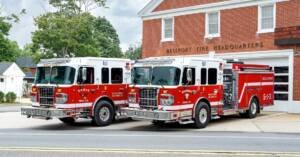
Occumbomock Engine Company
The Occumbomock Engine Company responds first due with engine 5-1-3 (pictured right) to all structure fires with its 2024 Spartan Pumper. The engine carries 800 gallons of water and pumps 2000 gallons per minute.
Eagle Hose Company
The Eagle Hose Company responds second due with engine 5-1-5 (pictured left), a twin to the Engine Company’s pumper except with the addition of built-in Hurst power tools for heavy rescue and vehicle extrication operations.
Buzzard Hook and Ladder Company
The Buzzard Hook and Ladder Company handles truck company operations with 5-1-13, a 2002 Pierce Aerial. The truck’s ladder extends 95 feet and its waterway supplies two master streams. The Pierce carries 300 gallons of water on board and can pump 2000 gallons per minute.
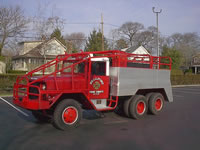
Brush Truck
Brush fires are handled using our custom-made brush truck, 5-1-12. Built on a government surplus truck chassis, 5-1-12 was designed and fabricated in-house by department members.
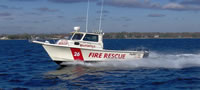
Parker Fire Boat
For fire or rescue operations on the water, the Bellport Fire Department responds using its 25 foot 2002 Parker Fire Boat. The boat now has a 200 gallon per minute pump and permanently mounted deck gun mounted on the bow.
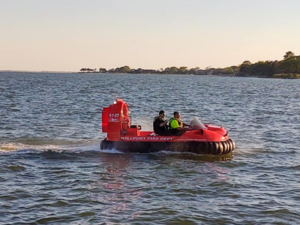
Rescue Hovercraft
The Bellport Fire Department utilizes its 2019 Hoverstream Rescue Hovercraft for specialized water, ice, marsh, and shallow-area rescue operations where traditional boats may not be able to safely respond.